Master the art of change management with Lewin's 3-step model: Unfreeze, Change, Refreeze. Perfect your change theory test skills with this comprehensive guide.
Master the art of change management with Lewin's 3-step model: Unfreeze, Change, Refreeze. Perfect your change theory test skills with this comprehensive guide.
Test Centre: Wood Green
Date: 22nd April 2026
Test Centre: Pinner
Date: 31th April 2026
Test Centre: Croydon
Date: 4th May 2026
Test Centre: Erith
Date: 7th May 2026
Test Centre: Barking (Tanner Street)
Date: 9th May 2025
Test Centre: Isleworth
Date: 18th May 2026
Test Centre: Hendon
Date: 4th May 2025
Test Centre: Hither Green
Date: 27th May 2026
Test Centre: Tolworth (London)
Date: 1st May 2026
Test Centre: Tolworth (London)
Date: 1st May 2026
Ever wondered why most New Year's resolutions are ancient history by February? Or why that new "super-efficient" system at work created more confusion than clarity? It's not a failure of willpower or a sign that your team is stubborn. According to decades of research, there’s a predictable pattern behind why some changes stick and others fail.
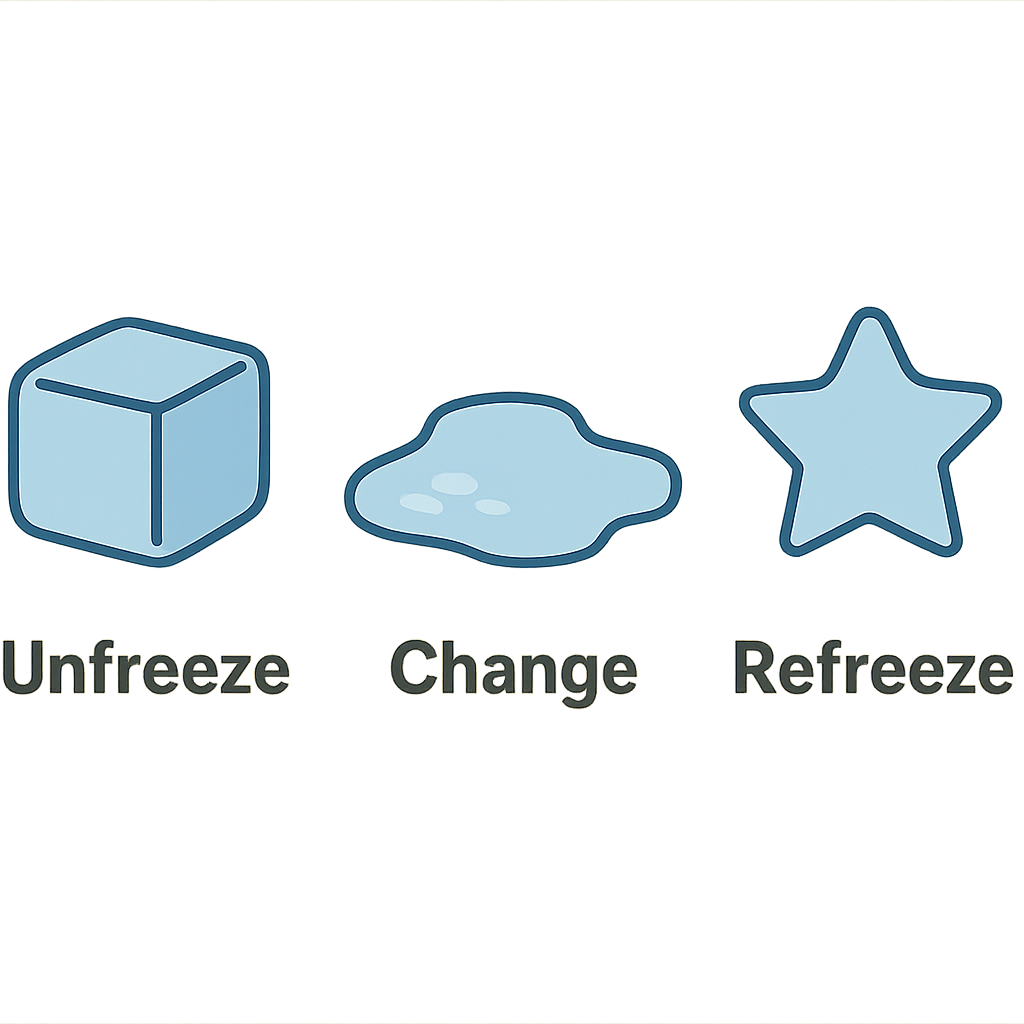
Imagine you have a solid ice cube, but you want a star-shaped piece of ice. You can't just chisel the cube into a star; it would likely shatter. To truly change its form, you have to do something else first: you must melt it.
This simple idea—melt, reshape, and freeze again—is the foundation of one of the most enduring change management models. Developed by social psychologist Kurt Lewin, his framework breaks the entire process down into three intuitive stages: Unfreeze, Change, and Refreeze. This model provides a clear map for a journey that often feels chaotic.
This framework helps you stop fighting against human nature and start working with it. Instead of just announcing a change and hoping for the best, you learn how to prepare people, guide them through the messy middle, and make the new way stick. We'll explore each stage to give you a simple mental model for making change work.
Remember our ice cube? You can't reshape it while it's frozen solid. The same is true for people and teams. The first step of any successful change, Unfreeze, isn’t about announcing the new plan; it’s about gently melting the current situation. This means getting everyone to agree that the old way of doing things—the frozen state—has problems that are worth solving. It’s a shift from talking about a future solution to having an honest conversation about a current pain point.
Jumping straight to the solution is why so many good ideas are met with scepticism or immediate resistance. When you announce a change out of the blue, it feels like something being done to people. But when you start by exploring the current challenges together, the dynamic flips. You’re not an authority imposing a fix; you’re a partner inviting others to help solve a problem they also experience. This simple act of asking questions is the best way to see if people are even ready for a change.
So, how does this look in the real world? It’s about changing how you start the conversation.
Instead of saying: "Starting Monday, all project updates go in the new software."
Try asking: "I've noticed we're losing track of updates in emails, and things are falling through the cracks. Has anyone else felt that?"
Instead of saying: "We're going on a new family budget."
Try asking: "I've been feeling stressed about our spending lately. Could we look at it together to see if we can find some breathing room?"
By unfreezing the situation first, you build a shared understanding of why a change is needed. You turn potential critics into collaborators. Once everyone agrees that the ice cube needs a new shape, you’re ready to navigate the messy middle phase: making the actual change.
Once you’ve successfully unfrozen the old way, you enter the second stage: Change. This is often the messiest part of the entire process. Think of our ice cube again—it’s no longer a solid block, but it’s not a new shape yet, either. It’s just a puddle. During this transitional phase, things can feel chaotic, confusing, and even less efficient than before. This dip in performance is completely normal and to be expected, not a sign that your idea has failed.
This feeling of chaos happens because people are caught between two worlds. They're letting go of old, comfortable habits while trying to learn new, unfamiliar ones. For instance, your team might struggle to remember to use the new software, or your family might forget to track a purchase for the new budget. It’s not resistance; it’s the natural clumsiness that comes with learning something new. Expect mistakes, frequent questions, and a bit of frustration as everyone finds their footing.
Your role during this stage is not to be an enforcer, but a guide. This is where clear, consistent, and patient communication becomes your most powerful tool. The goal isn't to demand perfection but to reduce anxiety and offer support. Check in frequently with simple questions like, "How's it going with the new system?" or "What's the trickiest part of this so far?" Providing resources, answering questions honestly, and simply listening can prevent people from giving up when things get tough.
By offering steady guidance, you help everyone move through the uncertainty together. This messy middle is temporary, but navigating it with patience is what makes the new way possible. Once the new habits start feeling more natural and the confusion fades, you’re ready for the final, crucial step: making the change stick for good.
After navigating the messy middle, it’s tempting to declare victory. But this is where many changes fall apart. Think back to our ice cube: you’ve melted it and poured the water into a new mould. The Refreeze stage is putting that mould back in the freezer to make the new shape permanent. Without this crucial final step, people can easily drift back to their old, comfortable habits, and all your hard work can evaporate.
Making the new habit stick isn't about one grand gesture; it’s about small, consistent actions that reinforce the change. You can celebrate a small win by publicly thanking a teammate for adopting the new process. Another powerful move is to formally update old rules or delete an outdated document to remove any confusion. Ultimately, the most effective strategy is making the new way the "path of least resistance"—the easiest and most obvious choice for everyone involved.
For instance, if your team adopts a new software, Refreezing means making it the only official place for project updates, removing the temptation of old email chains. This simple act signals the change is permanent and is the true measure of whether it will succeed in the long run. By deliberately locking in the new process, you create stability and prevent backsliding. Of course, even with a perfect plan, you'll still encounter hesitation. To manage this, it's essential to understand why people resist.
Even with a perfect plan, you will almost certainly encounter pushback. It’s tempting to label people who hesitate as "stubborn" or "difficult," but that view often misses the real story. Resistance isn't a character flaw; it's a natural human response to perceived loss. When you ask someone to adopt a new way of doing things, you’re also asking them to give something up, and that’s rarely comfortable.
Think about what is being lost. It's often not the old process itself but the comfort and predictability that came with it. People lose the feeling of being an expert, the ease of a familiar routine, or even the informal social connections built around the old way. Even a positive change, like a promotion, involves losing the familiar role and relationships of a previous job. Managing these psychological reactions to change is more important than managing the process itself.
This perspective helps us see resistance in a new light. People go through psychological stages when confronted with something new, and hesitation is part of that journey. Instead of viewing resistance as a battle to be won, try seeing it as a source of valuable information. The reasons people push back can reveal hidden flaws in your plan or highlight what they truly value about the current system—information you can use to make the transition smoother for everyone.
By listening to understand what people fear losing, you can address those concerns directly. This shifts the dynamic from a confrontation to a collaboration, paving the way for a solution that everyone can get behind.
Theory is one thing, but putting it into practice is what makes it valuable. The Unfreeze-Change-Refreeze model isn’t just for big corporate projects; it’s a powerful guide for implementing change in any part of your life. By turning abstract ideas into concrete steps, you can navigate transitions with far less friction.
Let’s ground this in a universal challenge: chaotic family dinners. Instead of just announcing a new menu and bracing for complaints, you can use the three stages to create a solution that actually sticks. This approach is a simple guide for implementing change, whether at home or with a small team at work.
Here’s what applying the theory looks like in reality:
1. Unfreeze: Call a quick family meeting. Don't start with a solution. Start with the problem: "I've noticed figuring out dinner has been really stressful lately. How is everyone feeling about it?" This opens the door for people to voice their own frustrations and agree that the current way isn't working.
2. Change: Suggest an experiment. "What if we try planning meals for just one week?" Get input, test a new system, and actively ask for feedback along the way. By treating it as a low-stakes trial, you lower the resistance to trying something new.
3. Refreeze: At the end of the week, discuss what worked and what didn't. Make adjustments based on feedback, then formalise the new plan by writing it down and sticking it on the fridge. It is now the new, official way of doing things.
Notice the difference? You didn't just force a change. You guided a conversation, managed the transition, and built a new routine together. Successfully applying change management theories means addressing the human side of the process, not just the logistics.
Before, failed changes—from a new family budget to a new tool at work—may have seemed like a simple matter of stubbornness or a lack of willpower. Now, you can see the hidden architecture behind any successful transition: you can’t reshape something solid without first melting it, guiding it into a new form, and letting it refreeze.
Your first test of this theory begins with your next observation. When you encounter a new initiative, ask yourself: "Did we unfreeze first?" Notice what happens when people are told to adopt a new process without first discussing why the old one is a problem. Seeing the stages in action is the first step toward making change less intimidating.
You no longer have to see change as an unpredictable force or a battle of wills. Viewing it as a predictable, three-part process trades anxiety for agency. You are no longer just subject to change; you are equipped to navigate it, building a smoother path that helps your best ideas take hold and truly last.
📚 Part of our Driving Test Booking Guide
This article is part of our comprehensive guide. View all Driving Test Booking articles →