Discover the true LGV test price in 2023, including hidden fees and costs for practical and theory tests. Start your driving career informed and empowered today!
Discover the true LGV test price in 2023, including hidden fees and costs for practical and theory tests. Start your driving career informed and empowered today!
Test Centre: Wood Green
Date: 22nd April 2026
Test Centre: Pinner
Date: 31th April 2026
Test Centre: Croydon
Date: 4th May 2026
Test Centre: Erith
Date: 7th May 2026
Test Centre: Barking (Tanner Street)
Date: 9th May 2025
Test Centre: Isleworth
Date: 18th May 2026
Test Centre: Hendon
Date: 4th May 2025
Test Centre: Hither Green
Date: 27th May 2026
Test Centre: Tolworth (London)
Date: 1st May 2026
Test Centre: Tolworth (London)
Date: 1st May 2026
That £2,500 'all-inclusive' LGV training course you’ve seen advertised often isn't the real story. The final bill frequently includes government test fees and other costs they don't mention, but our guide gives you the full, honest breakdown. The journey to becoming a professional driver starts with one simple, low-cost step that puts you in control from day one.
Before you can book training or even sit a theory test, you must pass a driver medical exam. This is a straightforward check-up where a doctor confirms your health meets the necessary standards for driving a large vehicle safely. They complete an official document called a D4 form, which is your key to starting the official licence application process with the DVLA.
Here’s your first chance to save money. In practice, booking this medical with a private service that specialises in driver medicals can cost as little as £50-£60, while going through your own GP might be over £100. Once you have that signed D4 form, applying for your provisional LGV licence entitlement is completely free.
Once you have your provisional licence, the next step is the theory phase. A common surprise for many aspiring drivers is that this isn't just one test like the one for your car. To become a professional LGV driver, you need to pass three separate computer-based tests, each covering a different area of knowledge and skill.
These official test fees are set by the Driver and Vehicle Standards Agency (DVSA), so the prices are fixed and won't change between training providers. Here’s the exact breakdown of what you’ll need to budget for:
In total, you’re looking at a fixed cost of £60 to complete your theory stage. This means your study plan needs to be broader than just reading the Highway Code; it must include practising hazard perception and understanding the day-to-day challenges of being a professional driver.
After clearing the theory stage, you’ll move on to practical, in-cab training. This is the biggest single investment on your journey to becoming a professional driver, and the part where prices can vary the most. While the £60 for theory tests is a fixed government fee, the hands-on training is provided by commercial schools, with costs that reflect their significant expenses.
So, when you see a price tag of £1,500 to £2,500, what are you actually paying for? A complete HGV training cost breakdown reveals it covers several key things: the exclusive use of a lorry that can cost over £100,000, the huge amount of fuel it uses, specialist insurance, and most importantly, the dedicated time of a qualified instructor sitting right beside you. These high overheads for the training provider are the reason for the substantial cost.
The price of these intensive HGV course prices typically covers a block of around 20 hours of training, often condensed into four or five consecutive days. This focused time is designed to build your skills and confidence rapidly, getting you from a complete beginner to test-ready in under a week. While finding affordable HGV training providers is a smart goal, be aware that price can sometimes reflect the age and quality of the vehicles you’ll be learning in.
This practical training package is the core of your budget, designed to get you to the required standard. However, it's vital to clarify with your chosen provider whether this price also includes the fees for the two final practical tests, which are the last hurdles you need to clear.
Once your practical training is complete, you'll need to pass two final, separate tests to get your licence. The first is the one you’d expect: the practical on-road driving test (officially called Module 3b). This is where you prove to an examiner that you can handle the lorry safely in real-world traffic and manoeuvre it correctly. The government-set LGV practical driving test fee for this is a standard £115.
In addition to driving, you must also pass the Driver CPC practical demonstration test (Module 4). This isn't about your driving skills. Instead, it’s a 30-minute test where you "show and tell" an examiner how you’d handle vehicle safety, secure loads, and assess risks. Think of it as proving you’re a responsible professional, not just a capable driver. The CPC Module 4 cost is a fixed £55.
Crucially, you need to confirm how these fees are handled. Together, the official DVSA LGV test booking fees total £170 (£115 + £55). Some training schools include this in their package price, while others will bill you for it as an extra on top of your training cost. Always ask your provider directly to avoid any surprise charges. The vehicle you test in will also be a key factor, which depends entirely on whether you're aiming for a "Class 2" or "Class 1" licence.
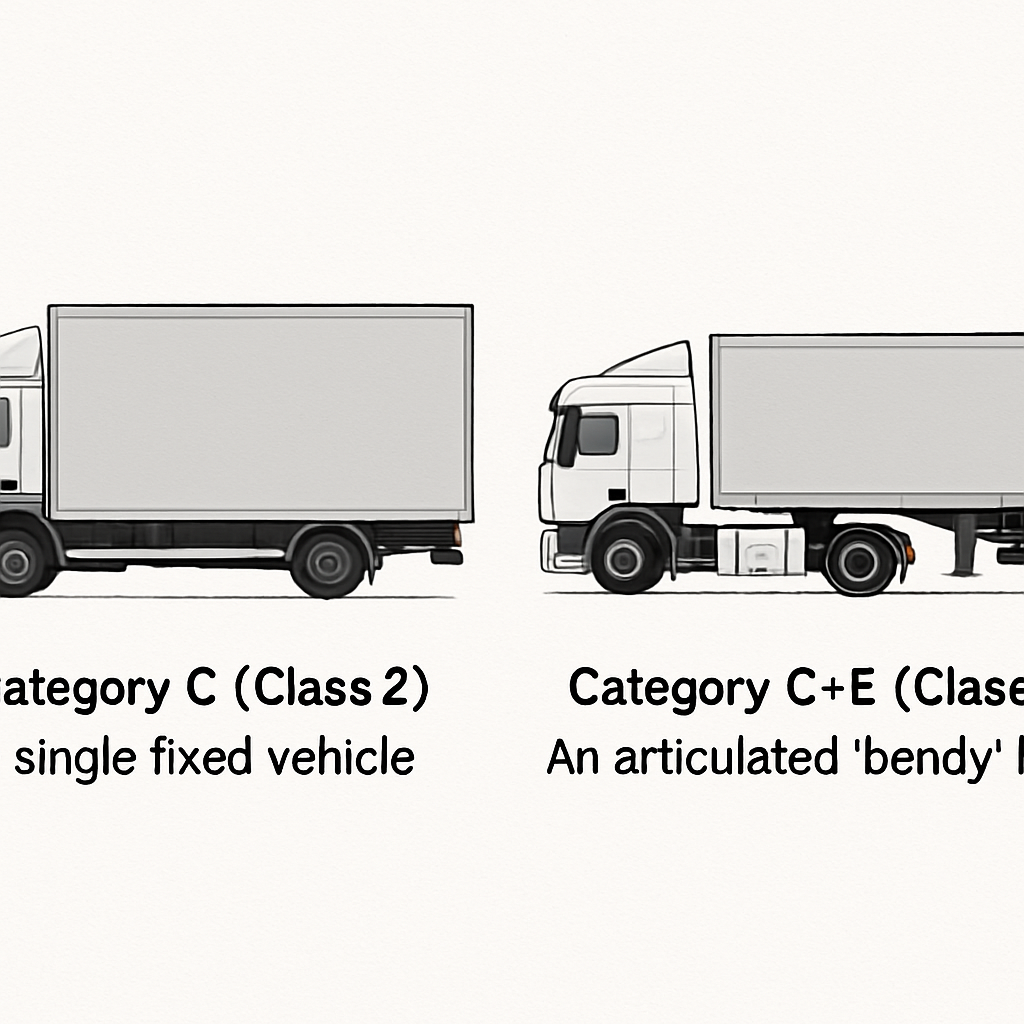
The final choice you'll make is what type of lorry you want to drive, which directly impacts the licence you need. You’ve likely heard the terms 'Class 2' and 'Class 1'. Officially, these are Category C for a 'Class 2' rigid lorry—where the cab and trailer are one fixed unit—and Category C+E for a 'Class 1' articulated lorry, the big 'bendy' trucks you see on motorways. Driving an articulated lorry requires more skill, which is reflected in the training.
This choice is crucial for your budget. You cannot go directly for the large articulated lorry (Cat C+E) licence from a car licence. First, everyone must pass the Category C test. From there, you can take a separate, shorter course and test to upgrade to C+E. This two-step process makes the initial hgv training cost breakdown more manageable, as you aren’t paying for everything at once.
Because training on a larger, articulated vehicle is more complex, the class 1 vs class 2 licence cost difference is significant, with the C+E upgrade often costing over £1,000. Many new drivers get their Category C licence to start working, and later have an employer help fund the C+E upgrade. This choice—between getting Cat C only or a combined C and C+E package—is where you'll see the biggest price variations from training schools.
As you start looking at training schools, you'll find prices are presented in two main ways: all-inclusive HGV driver training packages or a pay-as-you-go structure. Think of it like a holiday: an all-inclusive package wraps your flights, hotel, and food into one fixed price, while pay-as-you-go is like booking everything separately. Both have their pros and cons.
The main appeal of an all-inclusive package is simplicity and budget certainty. You pay one upfront fee that seems to cover everything from the medical to the final test. This can be great for peace of mind. The downside? You might pay for services you don’t use, like re-tests if you pass first time. A pay-as-you-go approach can seem cheaper initially, but costs can quickly add up if you need extra lessons or fail a test.
However, the term "all-inclusive" can be misleading. Finding truly affordable HGV training providers means knowing exactly what's included in an LGV training package. Some schools conveniently leave out exam fees, the medical, or charge a huge amount for a re-test, even in a "pass protection" deal.
Before committing thousands of pounds, you must ask direct questions. Use this simple checklist when you call a provider to make sure you’re comparing apples with apples:
Even with the best training, not everyone passes their practical test on the first try, and this is where a major hidden cost can appear. If you need to resit the driving test, you’re not just paying the standard £115 DVSA test fee again. You also have to pay to hire the multi-tonne lorry and your instructor for the test slot. This is why a single retest can easily add £350 to £450 to your bill, a critical detail to clarify when asking what's included in an LGV training package.
Beyond the tests themselves, there is another small but essential expense: your Digital Tachograph Card. This is a mandatory smart card, a bit like a credit card, that slots into the vehicle’s dashboard to record your driving hours and rest periods, ensuring safety rules are followed. Before you can start working as a professional driver, you must apply for one of these, which currently costs £32. It’s a non-negotiable part of a complete HGV training cost breakdown.
So, what's the bottom line? A smart rule of thumb is to add a 15-20% contingency fund to your main training budget. If your package is £2,500, that means having an extra £375 to £500 set aside. This buffer provides a vital safety net to cover potential LGV retest fees or other extras without derailing your career plans, turning a potential financial shock into a manageable bump in the road.
With the total cost in mind, many aspiring drivers wonder, are there grants for LGV training? While direct cash grants for individuals are extremely rare, that doesn’t mean you have to pay for it all yourself. The main route for government-funded training is through programs called "Skills Bootcamps," which are short, intensive courses often linked directly with employers who are hiring. These cover the full cost and are a fantastic way to get qualified without the upfront investment.
Another powerful path is employer sponsorship. Many large logistics, retail, and delivery companies are so keen to find new drivers that they will pay for your training from start to finish. In return, you typically agree to work for them for a set period. This can be a great way of finding affordable HGV training providers, as the company vets the school and handles the costs, removing the financial risk from your shoulders.
Whichever path you choose, the key milestones for getting qualified remain the same.
This guide provides a clear financial map, showing that the total investment—from the first medical form to your final practical test—will likely be between £2,000 and £3,500. This number is no longer an obstacle, but a goal you can plan for.
You now have the information needed to start the engine on your new career. Here is your simple, 3-step action plan:
Consider this your first and most important investment. With starting salaries for new drivers often topping £30,000, you can earn back the entire cost of your licence in just a few months of work. You now have a clear roadmap; the open road is waiting.
📚 Part of our Driving Test Booking Guide
This article is part of our comprehensive guide. View all Driving Test Booking articles →